Conversations with the researchers and explorers pushing the boundaries of what is humanly possible.
The black hole information paradox sits at the intersection of quantum mechanics and general relativity, two of our most successful theories of nature.
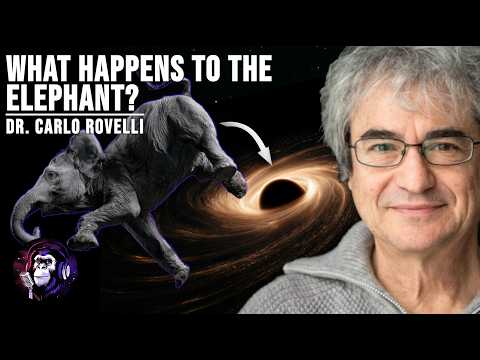
According to classical general relativity, anything that crosses the event horizon of a black hole is lost to the outside universe forever. Black holes are almost featureless. It doesnt matter if you build one from tea pots, or elephants, the information of what fell in is hidden forever.
But quantum mechanics tells a different story. In quantum theory, information cannot be destroyed. It can be scrambled, transformed, hidden, but never fundamentally erased. So what happens when these two ideas collide in the most extreme environment in the universe?
If a black hole forms from a star and later evaporates through Hawking radiation, what happens to the information about everything that fell in? Does it come back encoded in the radiation? Does it remain trapped forever? Or does physics itself break down at the boundary?
To make this concrete, imagine throwing a book into a black hole. If the black hole eventually evaporates completely, the total mass returns to the universe as radiation, but what happens to the detailed information inside that book? The words, the structure, the arrangement of matter that defined it? Depending on how you answer that question, you either preserve one of the deepest principles in quantum theory, or you are forced to accept that something fundamental about our understanding of reality is incomplete.
In this conversation, I speak with theoretical physicist Carlo Rovelli, one of the leading voices in quantum gravity, to explore the black hole information paradox. He outlines what the paradox is, explains where he belives many physicists get themselves confused, and puts forward his own solution to the paradox.
This publication is based upon work from COST Action RQI CA23115, supported by COST (European Cooperation in Science and Technology). COST is a funding agency for research and innovation networks. Our Actions help connect research initiatives across Europe and enable scientists to grow their ideas by sharing them with their peers. This boosts their research, career and innovation. For more information see: www.cost.eu .