Our understanding of gravity and black holes is currently in a funny spot that looks a little similar to how physics in general looked before quantum mechanics. Before quantum mechanics, scientists were puzzled by the stability of atoms. Shouldn't the negatively charged electrons simply fall into the positively charged nucleus? Also, the electrostatic force between charges was known to increase the closer two charged objects were to one another, and by naive extrapolation, this force should become infinite as the distance between objects goes to zero. This is known as a `singularity' in the theory. Singularities are usually a sign that our theory is being extrapolated beyond where it is applicable.
Quantum mechanics held the solution to the puzzle: electrons don't spiral around the nucleus; they sit in quantum orbits that can only take on certain discrete levels.
In our current understanding of gravity, there are objects predicted by the theory known as black holes. But just like with `classical' atoms, these objects are pretty weird. They have singularities right at the center, and just like the electrons orbiting an atomic nucleus, the classical theory of gravity says that matter should spiral into a black hole to meet the singularity. On the way, they cross an event horizon from which they can never return, and which shields anyone from looking into the black hole.
The singularity is an indication that our classical theory of gravity is somehow breaking down. But where? If we try to merge quantum mechanics with black holes, a clue arises: `Hawking' radiation is predicted by the merger to emanate from the black hole horizon, and this radiation leads to the evaporation of black holes, and the loss of all the information of anything that fell in.
But this behavior appears to break quantum mechanics because in quantum theory, information cannot be destroyed. It can be scrambled, transformed, hidden, but never fundamentally erased.
This is the black hole information paradox: the merger of our best gravitational theory and quantum theory seems to lead to information loss, which is incompatible with quantum theory.
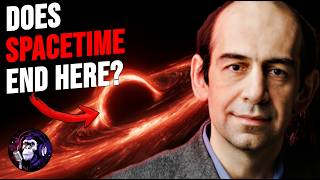
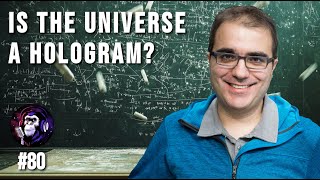
In this episode of the podcast, I speak with theorist Niayesh Afshordi. He suggests that the black hole information paradox arises because we are extrapolating our equations beyond where they make sense. His suggestion is a little unorthodox: black holes have no center. The horizon must be replaced with a surface, beyond which there is nothing. I speak with him to try to understand his suggestion.
This publication is based upon work from COST Action RQI CA23115, supported by COST
(European Cooperation in Science and Technology). COST is a funding agency for research and innovation networks. Our Actions help connect research initiatives across Europe and enable scientists to grow their ideas by sharing them with their peers. This boosts their research, career and innovation. For more information see: www.cost.eu .