Conversations with the researchers and explorers pushing the boundaries of what is humanly possible.
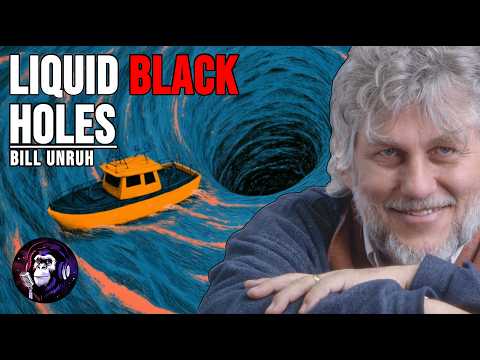
We can't put a real black hole in a laboratory, but we can recreate some of its most important physics. In this interview I speak with Bill Unruh, one of the pioneers of analog gravity.
The idea is fascinating: Usually we model gravity using equations and computer simulations, but there is another way. Rather than a gravitational black hole that can trap light from escaping, you can instead build a black hole using the flow in a fluid to trap sound from escaping. Such models really do mimic many of the properties predicted by the equations that describe black holes. Unruh explains how a waterfall can act as a sonic black hole, creating an analogue of a black hole event horizon where sound waves can become trapped.
In the lab, such analog systems have been built using water, but also Bose–Einstein condensates. One hope is to show that analog black holes sponateously emit sound quanta in exactly the same way that Hawking radiation is proposed to be emitted from Black holes. In particular, a key goal is to show that such radiation is `thermal', which would mean that it carries the least amount of information possible just as predicted by Hswking for black holes.
One of the key reasons for being interested in analog gravity, is that it can provide intuition about horizons and other aspects of gravitational systems that we can't explore in the lab. In this interview I ask Bill what intuition he has gained for one of the key paradoxes in gravitational physics that researchers are currently arguing over: The Black Hole Information Paradox. In particular, what happens to the information contained in matter that falls into a black hole? Can Hawking radiation carry that information back out? We also discuss what actually happens inside a black hole. Does the singularity represent a genuine physical feature, or does it signal that our current theory of gravity has reached its limits?
This publication is based upon work from COST Action RQI CA23115, supported by COST (European Cooperation in Science and Technology). COST is a funding agency for research and innovation networks. Our Actions help connect research initiatives across Europe and enable scientists to grow their ideas by sharing them with their peers. This boosts their research, career and innovation. For more information see: www.cost.eu .
Note: This interview has been cut from a longer conversation. For those interested, you can find the complete interview here: https://youtu.be/XnS02Ixc5_M